

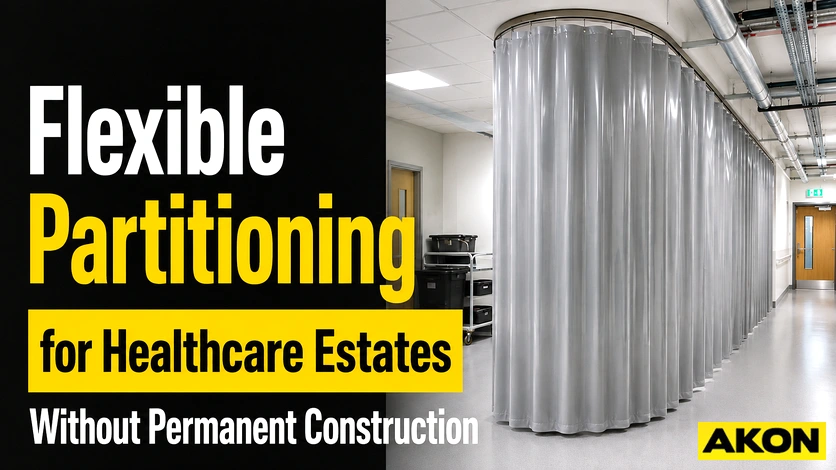

Healthcare estates teams are asked to do more with buildings that rarely stand still. Maintenance backlogs need clearing while wards and departments stay open, winter and surge pressures call for extra capacity at short notice, and services are reconfigured far more often than the fabric of a building was ever designed for. Closing a live healthcare building to carry out works is usually not an option.
Fixed construction has its place, but it is slow, costly, and disruptive. For the right applications, flexible partitioning offers a faster, reconfigurable alternative: track-mounted industrial curtains that can section off a works area today and be repositioned or removed when the project moves on. Used well, and within clear limits, it helps estates teams keep buildings running while change happens around them.
This post sets out where flexible curtain partitioning genuinely helps a healthcare estate, and, just as importantly, where it does not belong. AKON Curtains Limited supplies industrial partitioning for non-clinical, works-enabling applications, and being clear about that boundary is part of specifying it responsibly.
Where flexible partitioning fits in a healthcare estate
The strongest uses for industrial curtain partitioning in healthcare are non-clinical and works-enabling. They keep dust, debris, and visual disruption on one side of a line while the building carries on functioning on the other.
- Segregating works and refurbishment areas from the operational parts of a building, so a project can proceed without spreading dust and disturbance into occupied space. An industrial curtain wall can define that line quickly and be moved as the works progress.
- Creating decant space for the temporary relocation of non-clinical functions while their usual area is refurbished.
- Temporary non-clinical support space for storage, welfare, or administrative use during reconfiguration, using divider curtains to shape rooms within a larger footprint.
- Separating circulation routes during a project, so foot traffic and works traffic are kept apart.
- Back-of-house estates areas such as plant rooms, workshops, goods and logistics zones, catering and kitchen areas, and service corridors, where strip curtains and curtain walls help contain noise, dust, and temperature.
- Thermal and energy separation between heated and unheated zones. Insulated curtain walls can reduce heat loss across a large opening, which supports wider net zero efforts; where thermal performance matters, ask for the tested U-value in W/m²K rather than a general claim.
In each case the curtain is doing an industrial job: dividing space, containing dust and temperature, and adapting as the works programme changes. None of these uses touches patient care directly, which is exactly why they are a good fit.


The important boundary: what industrial curtains do not do
Clinical spaces are governed by requirements that industrial curtains do not, and cannot, address. Ventilation in clinical areas is covered by Health Technical Memoranda such as HTM 03-01, infection prevention and control sits with clinical teams, and fire compartmentation is a designed building function under HTM 05. An industrial curtain is not a substitute for any of these.
It is also worth being explicit about a common point of confusion. This is not about the antimicrobial cubicle or bed curtains that surround hospital beds. AKON Curtains Limited does not supply those; they are a separate clinical product with their own standards. Our curtains are industrial partitioning for estates and works applications, and we make no antimicrobial or infection-control claims for them.
Clinical cohorting and isolation are clinical decisions about how patients are managed, not something a physical barrier alone provides. A curtain can help organise a non-clinical space, but it does not create a clinically controlled environment. Being straight about this is a strength: it shows we understand where our product fits, and it helps estates teams avoid specifying the wrong thing for a critical space.
Specification considerations for healthcare estates
Where flexible partitioning is appropriate, a few technical points matter more in a healthcare building than almost anywhere else.
Fire performance. Specify fabric certified to BS 5867 Part 2 Type B, and to BS EN 13501-1 Euroclass where the project calls for it. Ask for the actual test certificate for the material being supplied, not a generic "flame retardant" description. The certificate is what a fire strategy review will want to see.
Coordination with the fire strategy. Any partitioning must be coordinated with the building's fire strategy under HTM 05 and the Regulatory Reform (Fire Safety) Order 2005. A curtain must never obstruct an escape route, block or shadow smoke detection, or interfere with sprinkler coverage.
Ventilation. Partitioning must not compromise airflow in ventilation-critical areas. If sectioning off a space would disrupt the designed air movement, that is a signal the application is not suitable and should be reviewed with the estates and ventilation teams.
Reconfigurability and durability. The value of curtain partitioning is that it moves. Track-mounted systems can be repositioned as a project evolves, and individual sections can be replaced without redoing the whole run, which suits the changing demands of a live estate.

How AKON Curtains Limited supports estates teams
AKON Curtains Limited supplies a range of industrial partitioning suited to estates and works applications: industrial curtain walls, warehouse and divider curtains, insulated curtain walls for thermal separation, strip curtains, and the track and hardware that make each system reconfigurable.
Our focus is on reconfigurability, correct specification, and working alongside estates and facilities teams rather than around them. We can supply the test documentation your fire strategy review needs, and advise on mounting, materials, and layout for the non-clinical spaces where curtains are the right tool.
As part of a group with many years of operational experience and more than fifteen years of specifier expertise, we bring practical knowledge of how these systems perform in demanding industrial settings. We are educational and technical by design here: we have not yet delivered UK healthcare installations, and we would rather help you specify correctly than overstate what a curtain can do.
Frequently Asked Questions About Healthcare Estates Partitioning
Can industrial curtains be used in clinical areas of a hospital?
Are these the same as antimicrobial bed or cubicle curtains?
Do the curtains provide fire compartmentation?
What fire certification should estates teams ask for?
Where is flexible partitioning genuinely useful in a healthcare estate?
Conclusion
Healthcare estates rarely get the luxury of closing a building to change it. Flexible curtain partitioning gives estates teams a fast, reconfigurable way to segregate works, create decant and support space, and manage back-of-house zones, all without the cost and permanence of fixed construction.
Its value comes from knowing exactly where it fits. Industrial curtains are an estates and works tool, not a clinical one, and they do not replace the ventilation, infection-control, and fire compartmentation requirements that govern patient spaces. Specified for the right applications, with the right fire certification and proper coordination with the fire strategy, they are a practical addition to an estates team's toolkit.
Planning Works in a Live Healthcare Building?
AKON Curtains Limited supplies reconfigurable industrial curtain partitioning for estates and works applications across the UK and Ireland. Talk to us about your non-clinical spaces and we can advise on specification, fire certification, and layout, or provide a quote for your project.
Get Specification GuidanceBlogPosting + Person + FAQPage + Organization JSON-LD. Editor only.
About the Author
Scott Fullerton is the Operations Manager at AKON Curtains Limited. With over 15 years of experience in industrial curtain and partitioning solutions, Scott oversees product development, technical specifications, and operations across the UK and Ireland. He helps estates and facilities teams specify the right industrial partitioning for non-clinical and works-enabling applications. Connect with Scott on LinkedIn.